Basics
BaZi for Beginners: A Complete Guide to Chinese Destiny Analysis
Learn BaZi from scratch: understand Heavenly Stems, Earthly Branches, Four Pillars, Five Elements, and the Day Master concept.
Learn BaZi from scratch: understand Heavenly Stems, Earthly Branches, Four Pillars, Five Elements, and the Day Master concept.
Key takeaways
- 01BaZi (八字), literally "Eight Characters," is one of the core methods in traditional Chinese destiny analysis.
- 02There are ten Heavenly Stems representing celestial energy, each with a Yin/Yang polarity and Five Element association
- 03There are twelve Earthly Branches corresponding to the Chinese zodiac animals, representing terrestrial energy
- 04The Year Pillar is determined by birth year and represents ancestors, family background, and early environment (roughly ages 0-16).
What Is BaZi
BaZi (八字), literally "Eight Characters," is one of the core methods in traditional Chinese destiny analysis. It uses a person's birth year, month, day, and hour, converting each into a pair of Heavenly Stem and Earthly Branch characters — four pairs totaling eight characters. These four pairs are also called the "Four Pillars" (Si Zhu/四柱) — Year Pillar, Month Pillar, Day Pillar, and Hour Pillar — which is why BaZi is also known as "Four Pillars of Destiny."
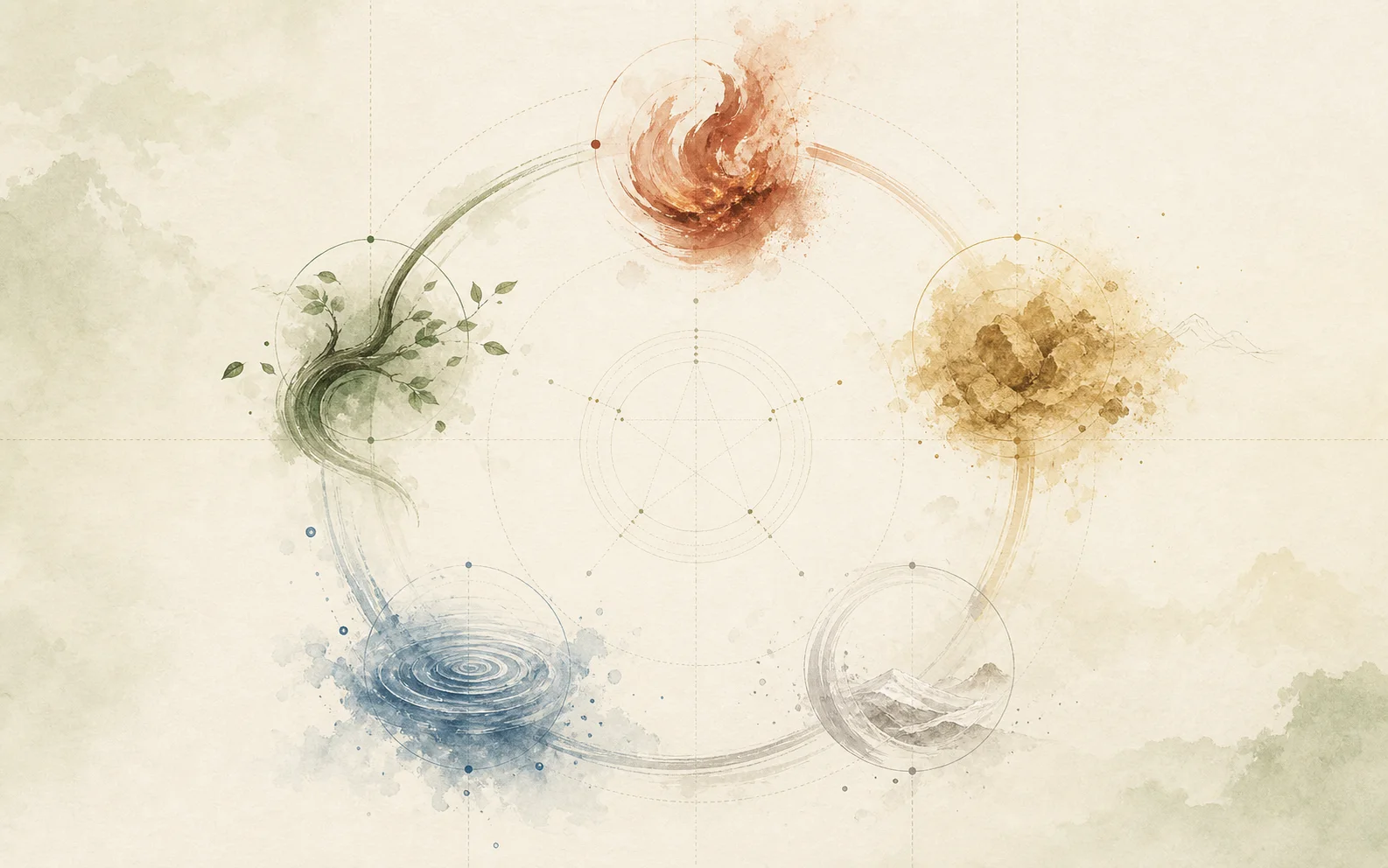
The fundamental concept is this: at the moment of birth, the state of Wu Xing (五行, Five Elements) energy between heaven and earth is "captured" in these eight characters. The combination and interaction of these energies reflect a person's character traits, life trajectory, and fortune cycles.
The Ten Heavenly Stems (Tian Gan / 天干)
There are ten Heavenly Stems representing celestial energy, each with a Yin/Yang polarity and Five Element association:
Memory aid: Jia-Yi Wood, Bing-Ding Fire, Wu-Ji Earth, Geng-Xin Metal, Ren-Gui Water. Each element has a Yang form (bold, outward) and a Yin form (gentle, inward).
The Twelve Earthly Branches (Di Zhi / 地支)
There are twelve Earthly Branches corresponding to the Chinese zodiac animals, representing terrestrial energy:
Earthly Branches are more complex than Heavenly Stems because each branch contains one to three "hidden" Heavenly Stems inside — this is the concept of "hidden stems within branches" (Di Zhi Cang Gan / 地支藏干), an intermediate topic.
Year Pillar: Ancestry and Foundation
The Year Pillar is determined by birth year and represents ancestors, family background, and early environment (roughly ages 0-16). The Year Pillar also determines your zodiac animal sign.
Month Pillar: Parents and Growth
The Month Pillar is determined by birth month (lunar calendar) and represents the parental relationship, growth environment, and young adulthood (roughly ages 16-32). The Month Pillar carries significant weight in BaZi analysis because it reflects the seasonal environment in which the Day Master exists, directly affecting Five Element strength assessments.
Day Pillar: Self and Spouse
The Day Pillar is the heart of BaZi analysis. Its Heavenly Stem is called the "Day Master" (Ri Zhu / 日主) or "Day Element" (Ri Yuan / 日元), representing the person themselves. Its Earthly Branch represents the "Spouse Palace," reflecting marital circumstances. The Day Pillar is the anchor of the entire chart — all analysis revolves around the Day Master.
Hour Pillar: Children and Later Years
The Hour Pillar is determined by birth hour (using the traditional twelve two-hour periods) and represents children and fortune in later life (roughly age 48 onward). It also reflects a person's innermost thoughts and subconscious tendencies.
Day Master: The Core of BaZi
The most critical step in understanding BaZi is identifying your Day Master — the Heavenly Stem of your Day Pillar, representing "you."
For example, if your Day Pillar is "Jia Zi" (甲子), your Day Master is Jia Wood. This means you are fundamentally like a great tree — deeply rooted, growing upward, principled and steadfast.
Each of the ten Day Masters has distinct characteristics:
- Jia Wood (甲) : Great tree personality — upright, responsible, stubborn
- Yi Wood (乙) : Flower and vine personality — flexible, adaptable, diplomatic
- Bing Fire (丙) : Sun personality — passionate, generous, attention-drawing
- Ding Fire (丁) : Candlelight personality — warm, delicate, insightful
- Wu Earth (戊) : Mountain personality — steady, reliable, inclusive
- Ji Earth (己) : Garden personality — gentle, nurturing, practical
- Geng Metal (庚) : Sword personality — decisive, resolute, loyal
- Xin Metal (辛) : Jewel personality — refined, sensitive, perfectionist
- Ren Water (壬) : Ocean personality — wise, broad-minded, unconstrained
- Gui Water (癸) : Rain personality — clever, perceptive, contemplative
Five Element Strength Assessment
After identifying the Day Master, the next step is determining its "strength." This requires examining the distribution of Five Element forces across the entire chart.
Assessment Criteria
Combining these four factors determines whether the Day Master is "strong" or "weak":
This assessment directly determines one of BaZi's most important concepts — the "Useful God" (Yong Shen / 用神): the element most beneficial to the chart's balance.
- Seasonal support (De Ling / 得令) : Is the Day Master's element in season during the birth month? (e.g., a Wood Day Master born in spring is seasonally supported)
- Rooted support (De Di / 得地) : Does the Day Master have roots in other Earthly Branches? (e.g., Jia Wood finding Yin or Mao in the branches)
- Generative support (De Sheng / 得生) : Do other elements nourish the Day Master? (e.g., Water generates Wood, so Water in the chart helps a Wood Day Master)
- Companion support (De Zhu / 得助) : Are there same-element allies? (e.g., Jia Wood seeing Yi Wood means shared Wood energy)
- Strong Day Master : Ample energy, needing draining and controlling forces for balance
- Weak Day Master : Insufficient energy, needing generating and supporting forces for reinforcement
Ten Gods: The Code of Relationships
In BaZi, the Five Element relationships between the other seven characters and the Day Master are systematized into the "Ten Gods" (Shi Shen / 十神) framework — a key tool for analyzing personality, career, and relationships:
- Bi Jian and Jie Cai (same element as Day Master): Siblings, friends, competitors
- Shi Shen and Shang Guan (element the Day Master produces): Talent expression, children
- Pian Cai and Zheng Cai (element the Day Master controls): Wealth, father (also wife in male charts)
- Qi Sha and Zheng Guan (element that controls the Day Master): Pressure, authority, superiors (also husband in female charts)
- Pian Yin and Zheng Yin (element that produces the Day Master): Knowledge, mother, benefactors
Da Yun and Annual Fortune
BaZi represents your "innate destiny" — the energy configuration at birth. But fortune is dynamic, introducing two concepts:
For example, someone with a weak Day Master needing Water support will thrive during Water-dominant Da Yun periods and struggle during Fire-dominant ones. Annual Fortune further refines how fortune manifests within each Da Yun cycle.
- Da Yun (大运, Major Luck Cycles) : Ten-year periods of fortune shifts that determine life's major directions
- Liu Nian (流年, Annual Fortune) : Year-by-year fortune changes that determine specific auspicious and inauspicious events
Step One: Chart Your BaZi
You need your Gregorian birth date and accurate birth time, then convert these into Heavenly Stem and Earthly Branch combinations using a perpetual calendar or charting tool. The Daolyn platform can do this automatically — simply enter your birth information and the system generates your complete BaZi chart.
Step Two: Find Your Day Master
Identify the Heavenly Stem of your Day Pillar — this is "you" in the BaZi system.
Step Three: Analyze Five Element Distribution
Examine how much Metal, Wood, Water, Fire, and Earth exist across your eight characters, noting which are strong and which are weak.
Step Four: Determine the Useful God
Based on Day Master strength and Five Element balance principles, identify the element most beneficial to your chart.
Take It Step by Step
BaZi is a vast and profound discipline that cannot be mastered overnight. Start by practicing with your own chart and those of family members, combining theory with real cases to gradually deepen your understanding.
Want a quick look at your BaZi? Try Daolyn's AI-powered BaZi analysis and receive a professional destiny reading in just minutes.