Basics
The Five Elements: Understanding the Foundational Logic of Destiny
A deep dive into Wu Xing — the generation and controlling cycles of the Five Elements and how they underpin BaZi destiny analysis.
A deep dive into Wu Xing — the generation and controlling cycles of the Five Elements and how they underpin BaZi destiny analysis.
Key takeaways
- 01Wu Xing (五行, the Five Elements) theory is one of the cornerstones of Chinese philosophy, standing alongside Yin-Yang the
- 02Movement direction : Upward, outward expansion
- 03Movement direction : Upward, dispersing
- 04Movement direction : Centered, bearing
The Five Elements: A Fundamental Framework for Everything
Wu Xing (五行, the Five Elements) theory is one of the cornerstones of Chinese philosophy, standing alongside Yin-Yang theory as a fundamental framework for understanding the universe. The Five Elements — Metal (Jin/金), Wood (Mu/木), Water (Shui/水), Fire (Huo/火), and Earth (Tu/土) — are not merely five substances but five fundamental patterns of energy movement.
In BaZi (八字) destiny analysis, the Five Elements serve as the foundational "operating system." Heavenly Stems and Earthly Branches are essentially different manifestations of the Five Elements, and all BaZi analysis ultimately returns to the generation, controlling, and transformation relationships between them. Understanding the Five Elements means grasping the core logic of destiny analysis.
Wood (Mu / 木)
- Movement direction : Upward, outward expansion
- Season : Spring
- Qualities : Growth, development, benevolence, creativity
- Body correspondence : Liver, gallbladder, tendons, eyes
- Personality : Principled, planful, growth-oriented
- Heavenly Stem representatives : Jia (Yang Wood, great tree), Yi (Yin Wood, flowers)
Fire (Huo / 火)
- Movement direction : Upward, dispersing
- Season : Summer
- Qualities : Passion, propriety, civilization, expression
- Body correspondence : Heart, small intestine, blood vessels, tongue
- Personality : Passionate, expressive, attention-seeking
- Heavenly Stem representatives : Bing (Yang Fire, sun), Ding (Yin Fire, candlelight)
Earth (Tu / 土)
- Movement direction : Centered, bearing
- Season : Transitional periods between seasons (late summer)
- Qualities : Inclusiveness, stability, trustworthiness, mediation
- Body correspondence : Spleen, stomach, muscles, mouth
- Personality : Steady, trustworthy, sometimes stubborn
- Heavenly Stem representatives : Wu (Yang Earth, mountain), Ji (Yin Earth, garden)
Metal (Jin / 金)
- Movement direction : Inward, consolidating
- Season : Autumn
- Qualities : Decisiveness, justice, restraint, severity
- Body correspondence : Lungs, large intestine, skin, nose
- Personality : Decisive, principled, sometimes overly harsh
- Heavenly Stem representatives : Geng (Yang Metal, sword), Xin (Yin Metal, jewels)
Water (Shui / 水)
- Movement direction : Downward, moistening
- Season : Winter
- Qualities : Wisdom, flexibility, communication, flow
- Body correspondence : Kidneys, bladder, bones, ears
- Personality : Clever, adaptable, sometimes overthinking
- Heavenly Stem representatives : Ren (Yang Water, ocean), Gui (Yin Water, rain)
The Generation Cycle: Nourishment in Motion
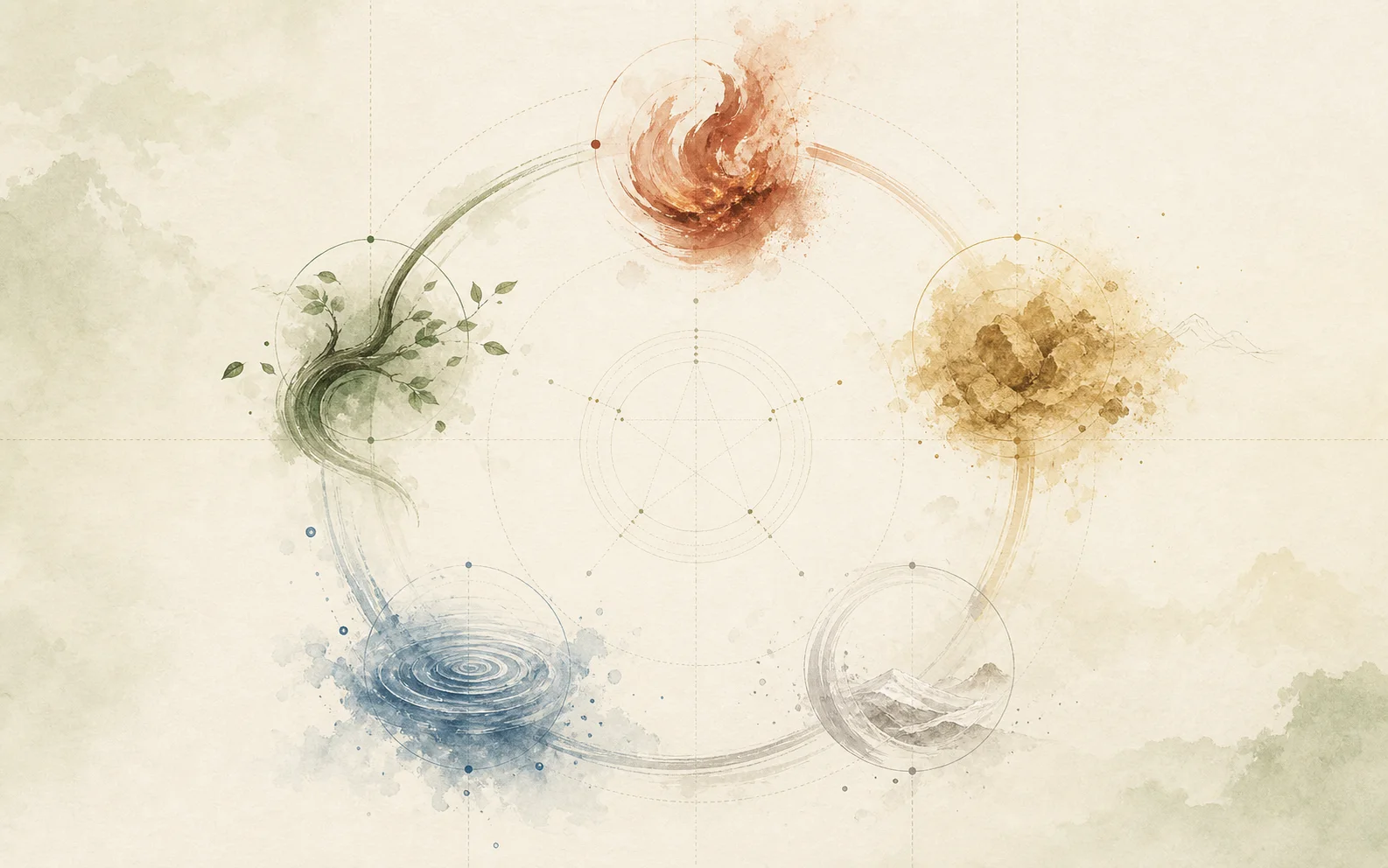
The Five Element generation sequence is: Wood generates Fire, Fire generates Earth, Earth generates Metal, Metal generates Water, Water generates Wood.
This forms a perpetual cycle where each element is nourished by the one before it and nourishes the one after it.
The Logic Behind Generation
- Wood generates Fire : Wood burns to produce flame — trees provide fuel for fire
- Fire generates Earth : Combustion produces ash that returns to the earth; volcanic ash enriches soil
- Earth generates Metal : Metal ores are contained within the earth, formed through geological accumulation
- Metal generates Water : Ancient Chinese observed dew condensing on metal surfaces at dawn — metal has Water-gathering properties
- Water generates Wood : Trees need water to grow — water is the source of plant life
Generation in BaZi Application
In BaZi analysis, the generation relationship manifests as a dynamic of "giving" and "receiving":
An important principle is "excessive generation becomes drainage" — while the receiver gains strength, if too much is generated, the giver becomes exhausted. A tree that constantly pours nutrients into blooming flowers may itself grow weak.
- The receiver gains strength : Water generates Wood — if your Day Master is Wood, Water in your chart represents resources and support (corresponding to the "Seal Star" / Yin Xing — representing education, elders, benefactors)
- The giver expends itself : Wood generates Fire — if your Day Master is Wood, Fire in your chart represents your output and expression (corresponding to "Output Stars" / Shi Shang — representing talent, creativity, children)
The Controlling Cycle: The Power of Balance
The Five Element controlling sequence is: Wood controls Earth, Earth controls Water, Water controls Fire, Fire controls Metal, Metal controls Wood.
Controlling does not mean "destroying" but "restraining" and "regulating" — an indispensable force for maintaining system balance.
The Logic Behind Controlling
- Wood controls Earth : Tree roots penetrate soil, extracting nutrients, imposing restraint on Earth
- Earth controls Water : Dams are built from earth to block water flow — Earth directs Water's course
- Water controls Fire : Water extinguishes flame — the most intuitive controlling relationship
- Fire controls Metal : High temperatures melt metal — Fire transforms Metal's form
- Metal controls Wood : Metal tools fell trees — the axe against the tree exemplifies Metal controlling Wood
Controlling in BaZi Application
The intensity of controlling matters greatly:
- What controls me is "Officer/Killer" (Guan Sha / 官杀): Represents pressure, discipline, authority, and career challenges and opportunities (also represents husband in female charts)
- What I control is "Wealth" (Cai Xing / 财星): Represents resources I can command and acquire, namely wealth (also represents wife in male charts)
- Moderate controlling : Restraint without harm, maintaining balance — this is beneficial
- Excessive controlling : Power disparity too great, the weaker party is injured and needs remedy
- Reverse controlling : When the supposedly weaker party is actually too strong, it overwhelms the controller — for instance, weak Fire attempting to control strong Metal gets extinguished by Metal's cold energy instead
Dynamic Balance of Generation and Controlling
Truly advanced Five Element analysis goes beyond simple generation and controlling pairs to examine the dynamic balance of the entire system.
The Bridging Concept (Tong Guan / 通关)
When an excessively strong controlling relationship forms between two elements, a "bridging" element can be introduced to resolve it. For example:
This principle is critically important in BaZi analysis and forms one of the core logics for selecting the "Useful God" (Yong Shen / 用神).
- Metal over-controlling Wood → Introduce Water: Metal generates Water, Water generates Wood — Water bridges the gap and protects Wood from Metal's harm
- Wood over-controlling Earth → Introduce Fire: Wood generates Fire, Fire generates Earth — Fire bridges the gap and resolves Wood's suppression of Earth
Quantitative and Qualitative Changes
Five Element strength is not fixed — it shifts based on:
- Monthly command (Yue Ling / 月令) : The birth month determines which element is strongest (e.g., Wood dominates in spring, Fire in summer)
- Combinations : Combinations, clashes, punishments, and harms between Stems and Branches alter elemental strength
- Proximity : Elements closer to the Day Master exert greater influence; distant ones have less impact
- Da Yun and Annual Fortune : As time progresses, new elemental energies enter, disrupting the original balance
Five Elements in Daily Life
Understanding the Five Elements benefits not only BaZi analysis but also guides everyday decisions:
Career Selection
- Wood industries : Education, publishing, fashion, forestry, traditional medicine
- Fire industries : Technology, media, food service, electric power, performing arts
- Earth industries : Real estate, construction, agriculture, warehousing, insurance
- Metal industries : Finance, law, machinery, automotive, jewelry
- Water industries : Logistics, tourism, fisheries, consulting, communications
Health and Wellness
Five Element imbalances manifest in corresponding body systems. Adjusting diet, exercise, and lifestyle habits can partially compensate for deficient elements. For example, people with weak Wood can eat more green vegetables, spend time in nature, and do stretching exercises.
Interpersonal Relationships
Understanding your own and others' Five Element profiles helps explain interaction dynamics. For instance, Fire-type and Water-type people together may create conflict, but a Wood-type person in between can harmonize them (Water generates Wood, Wood generates Fire), creating a smoother relationship.
Summary
The Five Elements' generation and controlling cycles are not superstition but a highly abstract and systematic observation of natural patterns by ancient Chinese thinkers. In BaZi destiny analysis, the Five Elements are the bridge connecting Heavenly Stems and Earthly Branches to human destiny. Master the basic logic of the Five Elements, and you possess the core tool for reading BaZi charts.
Of course, theory must be combined with practice. Want to see how the Five Elements are distributed and interacting in your own BaZi chart? Try Daolyn's AI-powered BaZi analysis to visually understand your Five Element configuration and destiny trajectory.