Basics
Is MBTI Outdated? China Had a More Precise Personality System 2,000 Years Ago
MBTI offers 16 personality types — BaZi offers over 500,000 combinations. From Five Elements personalities to life rhythm, discover how ancient Chinese built a more precise personality system two millennia before MBTI.
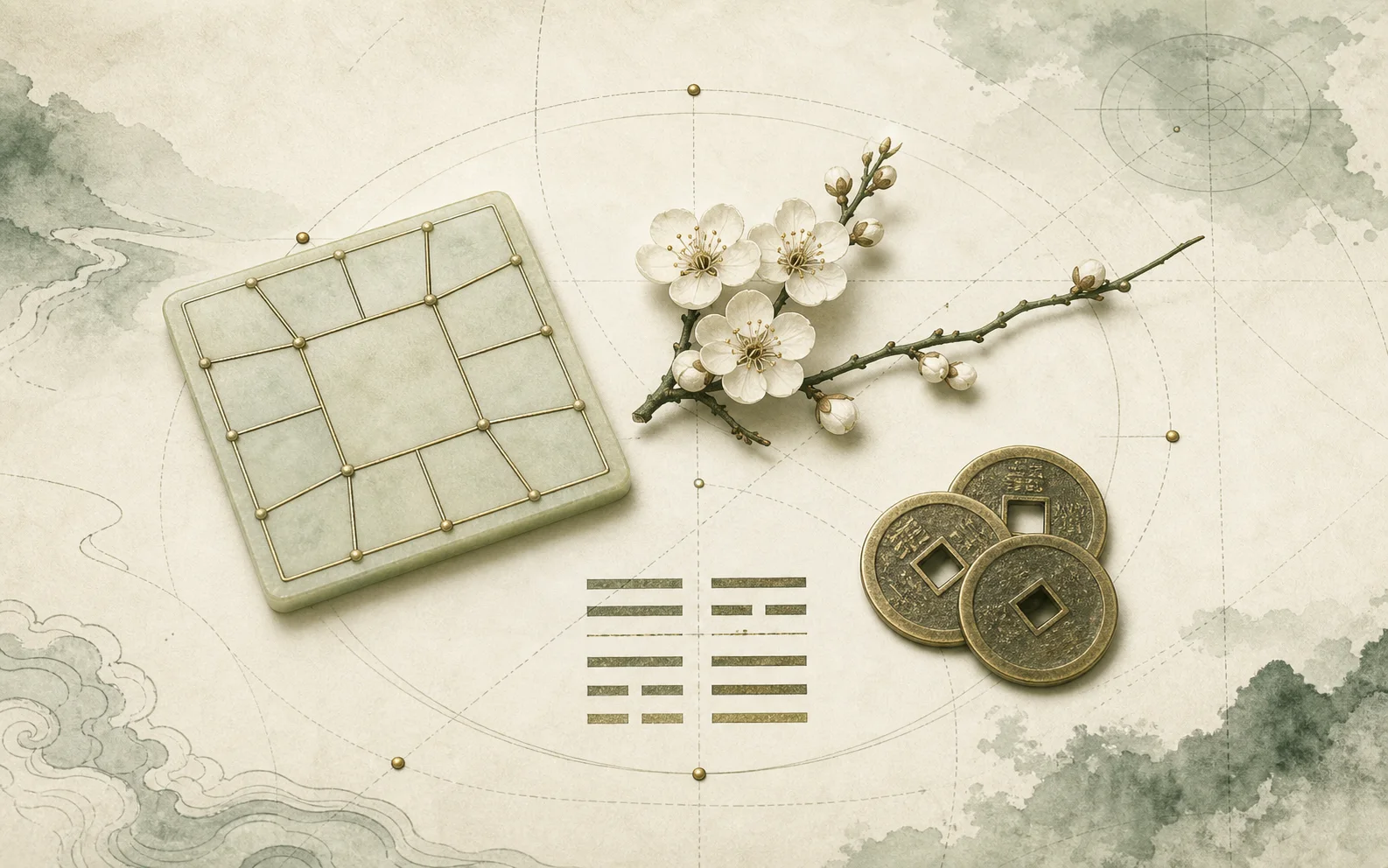
MBTI offers 16 personality types — BaZi offers over 500,000 combinations. From Five Elements personalities to life rhythm, discover how ancient Chinese built a more precise personality system two millennia before MBTI.
Key takeaways
- 01MBTI has taken the internet by storm.
- 02A quick comparison
- 03The skeleton is surprisingly simple
- 04When MBTI tells you "you're an INFP — the Mediator," most people still walk away unsure what that actually means.
Overview
MBTI has taken the internet by storm. People ask "Are you an I or an E?" on first meeting, and INFP or ENTJ has become a default line in dating profiles. What most people don't realize: China had a far more precise personality system more than two thousand years ago — the Heavenly Stems and Earthly Branches (BaZi).
MBTI: 16 Answers vs BaZi: Tens of Thousands of Combinations
A quick comparison:
MBTI hands you one of 16 labels. But no one is truly a "pure type." BaZi doesn't pick one out of sixteen — it locates your exact coordinates within a system of Heavenly Stems × Earthly Branches × Four Pillars , calculated from the moment you were born.
The Framework: 10 × 12 × 4
The skeleton is surprisingly simple:
The moment you were born, the sky and time handed you an "ID card" with four pairs of Stems and Branches — eight characters in total. That's what "BaZi" (literally "eight characters") means.
Behind these eight characters lie five elemental energies: Metal, Wood, Water, Fire, Earth . How they flow, generate, and restrain each other forms the baseline of your personality and life rhythm.
- 10 Heavenly Stems : Jia, Yi, Bing, Ding, Wu, Ji, Geng, Xin, Ren, Gui
- 12 Earthly Branches : Zi, Chou, Yin, Mao, Chen, Si, Wu, Wei, Shen, You, Xu, Hai
- Four Pillars : Your birth year, month, day, and hour — each producing one Stem and one Branch
Five Elements Personality: More Visual Than MBTI
When MBTI tells you "you're an INFP — the Mediator," most people still walk away unsure what that actually means. The Five Elements give you an image instead:
🌳 Wood — The Free Spirit
Like a tree in spring, always reaching upward. Opinionated, driven, restless. That friend who can't stand a cubicle and always wants to build something — their chart is probably Wood-heavy.
Closest MBTI echo: ENFP / ENTP, but with more "growth drive" than "exploration drive."
🔥 Fire — The Performer
Warm, magnetic, the center of any room. Fire types carry their own spotlight — loud laugh, expressive face, emotions that rush in and out quickly.
Closest MBTI echo: ESFP / ENFJ, always at full social battery.
🪨 Earth — The Anchor
The most reliable person in your group chat. Steady, patient, accommodating, never competes for spotlight. When you need real advice, they're who you text first.
Closest MBTI echo: ISFJ / ESFJ — but with even more emphasis on "holding space."
⚔️ Metal — The Principle
Decisive, sharp, clear-headed, never drags their feet. Metal types have an invisible line, and crossing it triggers an immediate response.
Closest MBTI echo: ESTJ / INTJ's decisiveness, but with a blade-like edge.
🌊 Water — The Sage
Clever, adaptive, deeper than they appear. Water types look easygoing on the surface but quietly understand everything. Observant, fluid, exceptionally adaptable.
Closest MBTI echo: INTP / INFJ, but more "flowing" — never fixated on a single shape.
Why BaZi Is More Precise Than MBTI
Three key differences:
1. MBTI is static; BaZi is dynamic. MBTI tells you "which type you are." BaZi tells you your baseline personality and the rhythm of different life stages — when to push forward, when to hold back, which years are likely turning points.
2. MBTI is self-report; BaZi is objective data. When you take an MBTI test, you're partly answering "who I wish I were." BaZi only needs your birth time — it's unaffected by your current mood, life phase, or how you want to present yourself.
3. MBTI describes individuals; BaZi describes relationships. BaZi has a dimension MBTI lacks: the generation and restraint cycles of the Five Elements . Wood feeds Fire, Fire produces Earth, Water restrains Fire… this isn't just about you — it also explains the dynamics between you and your parents, partner, or colleagues.
A Common Misconception: Determinism?
Many people furrow their brows when they hear "BaZi": "Isn't that just fortune-telling?"
Not really. BaZi's core isn't "what you're doomed to become," but "what your energetic baseline is, and which rhythms suit you best."
Here's an analogy: a weather forecast doesn't change the weather, but it helps you decide what to wear and whether to bring an umbrella. BaZi works the same way — understanding your pattern lets you work with the flow, not against it.
Interestingly, Jiayi Weng, a core engineer at OpenAI, recently made a similar point publicly: he believes "destiny can be predicted," and that this kind of prediction isn't meant to trap people — it's meant to help them live with more clarity. AI understands the world through pattern recognition; the ancients understood people through Stems and Branches. Different methods, same underlying insight.
MBTI Tells You Who You Think You Are. BaZi Tells You Who You've Always Been.
That's my favorite way to summarize the difference.
MBTI is a mirror — it reflects your conscious self-perception . BaZi is closer to a "cosmic coordinate map" taken at birth, tracing the shape of who you were before society shaped you .
They aren't in conflict. Knowing your MBTI helps you communicate with others; knowing your BaZi helps you understand why you are the way you are — and where you're headed.
Curious About Your Own BaZi?
If you've read this far and you're curious, try Daolyn's AI-powered BaZi analysis. All it needs is your birth time — it combines modern AI with traditional destiny studies to generate an in-depth report on your personality and life rhythm.
It's not fortune-telling. It's a new way to meet yourself .