Basics
What is BaZi
BaZi is the core method of Chinese destiny analysis, reading fate through the Heavenly Stems and Earthly Branches of your birth time. A complete beginner's guide.
BaZi is the core method of Chinese destiny analysis, reading fate through the Heavenly Stems and Earthly Branches of your birth time. A complete beginner's guide.
Key takeaways
- 01"BaZi" (八字) literally translates to "eight characters.
- 02The roots of BaZi stretch back to the Tang Dynasty (618-907 CE).
- 03Each of the four pillars corresponds to a different dimension of life
- 04The Year Pillar represents your family foundation , ancestral heritage, and your position within the broader social environment.
What Does "BaZi" Mean?
"BaZi" (八字) literally translates to "eight characters." These eight characters are derived from four time points of your birth — the year, month, day, and hour. Each time point is represented by two Chinese characters: one Heavenly Stem and one Earthly Branch , forming what is called a "pillar." Four pillars times two characters each gives us eight characters — hence the name BaZi.
In Chinese metaphysical tradition, BaZi is also known as "Four Pillars of Destiny" or "Zi Ping Method" (子平术). It is a comprehensive destiny analysis system that interprets the cosmic energy configuration at the moment of your birth to understand your personality, life trajectory, and potential.
Historical Origins
The roots of BaZi stretch back to the Tang Dynasty (618-907 CE). Early forms of Chinese destiny analysis relied primarily on the Year Pillar, which provided only a rough picture. The real breakthrough came during the Song Dynasty (960-1279 CE), when the master astrologer Xu Zi Ping (徐子平) revolutionized the system by shifting the focus to the Day Pillar's Heavenly Stem — known as the Day Master — as the center of analysis. This dramatically increased the system's precision and depth.
In honor of his contributions, later generations named the method "Zi Ping Shu" (子平术). Over the following centuries — through the Yuan, Ming, and Qing dynasties — successive scholars refined the system into the rigorous and comprehensive framework we use today. BaZi is not superstition; it is the ancient Chinese synthesis of temporal patterns and natural law.
The Four Pillars Explained
Each of the four pillars corresponds to a different dimension of life:
Year Pillar — Roots and Ancestry
The Year Pillar represents your family foundation , ancestral heritage, and your position within the broader social environment. Think of it as the roots of a tree — it determines the soil you grow in. In practice, the Year Pillar is used to assess early life fortune (roughly ages 1-16) and the relationship with grandparents.
Month Pillar — Core Energy and Career
The Month Pillar is one of the most critical pillars in the entire chart. It represents your parents, siblings, and serves as the "Career Palace." The Month Pillar's energy directly determines the strength or weakness of the Day Master, making it the key to understanding the overall chart structure. It corresponds to approximately ages 17-32 — the golden period of education and career establishment.
Day Pillar — Self and Marriage
The Day Pillar's Heavenly Stem is the Day Master — it represents you. The Day Pillar's Earthly Branch is called the "sitting branch" or "Spouse Palace" , representing your most intimate partnership. The Day Pillar is the absolute center of a BaZi chart; every analysis radiates outward from it. It corresponds to approximately ages 33-48.
Hour Pillar — Children and Later Life
The Hour Pillar represents your children , your inner world, and the quality of your later years. It also reflects your deepest aspirations and ultimate legacy. It corresponds to approximately age 49 and beyond. A favorable Hour Pillar often indicates happiness in old age and successful offspring.
The Ten Heavenly Stems
There are ten Heavenly Stems: Jia, Yi, Bing, Ding, Wu, Ji, Geng, Xin, Ren, Gui (甲乙丙丁戊己庚辛壬癸).
They represent heavenly energy, each associated with one of the Five Elements:
- Jia & Yi → Wood (Jia is yang wood — a towering tree; Yi is yin wood — flowers and vines)
- Bing & Ding → Fire (Bing is yang fire — the blazing sun; Ding is yin fire — candlelight)
- Wu & Ji → Earth (Wu is yang earth — mountains and boulders; Ji is yin earth — fertile farmland)
- Geng & Xin → Metal (Geng is yang metal — swords and ore; Xin is yin metal — jewelry and refined metal)
- Ren & Gui → Water (Ren is yang water — rivers and oceans; Gui is yin water — rain and morning dew)
The Twelve Earthly Branches
There are twelve Earthly Branches: Zi, Chou, Yin, Mao, Chen, Si, Wu, Wei, Shen, You, Xu, Hai (子丑寅卯辰巳午未申酉戌亥).
The Earthly Branches represent terrestrial energy. Each branch contains one to three "hidden stems" inside it, making their elemental composition more complex than the Heavenly Stems. The twelve branches also correspond to the twelve Chinese zodiac animals: Rat, Ox, Tiger, Rabbit, Dragon, Snake, Horse, Goat, Monkey, Rooster, Dog, and Pig.
The Five Elements: The Language of BaZi
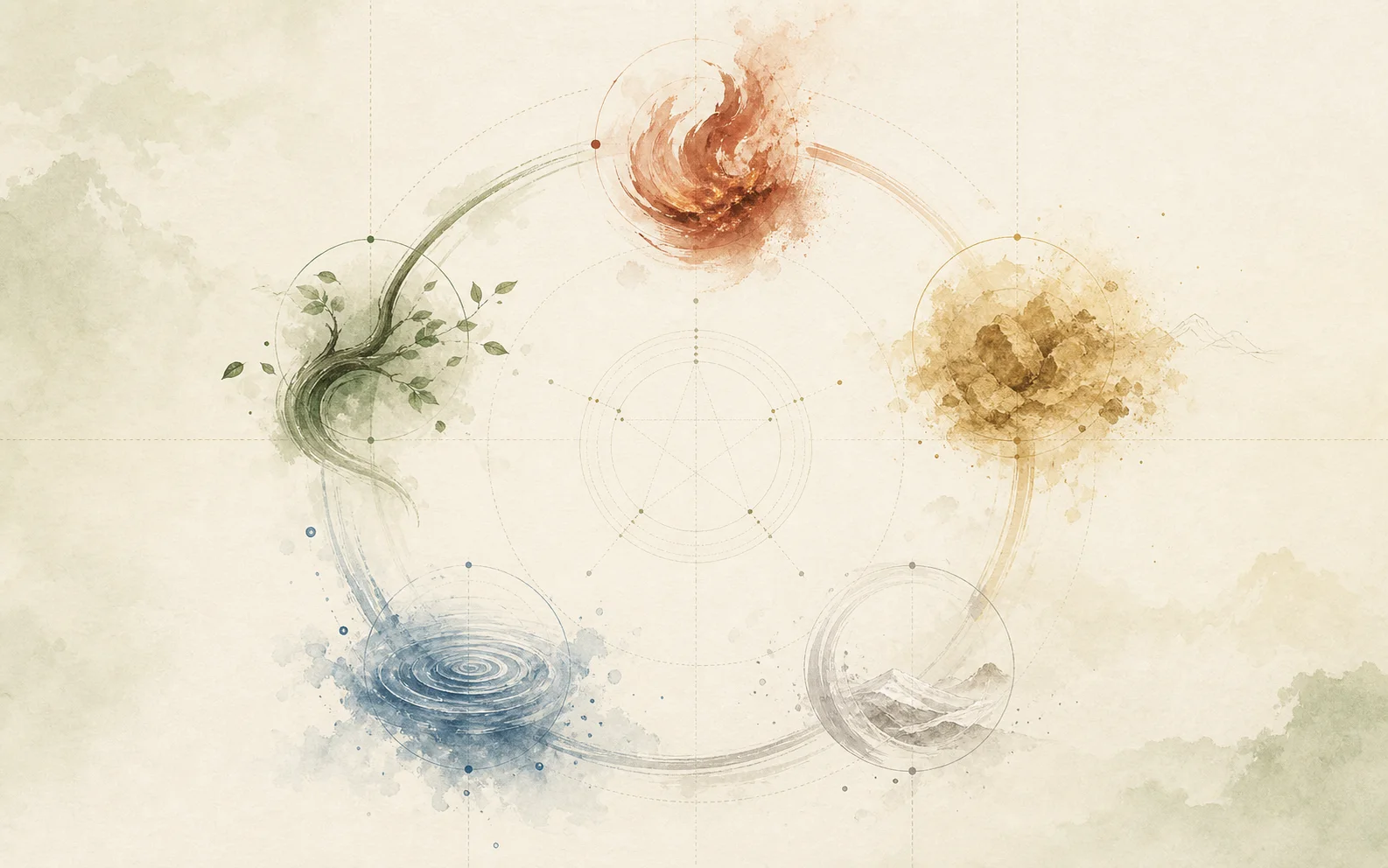
The Five Elements — Wood, Fire, Earth, Metal, Water — form the foundational language of all BaZi analysis.
The Generating Cycle (Creative Flow)
- Wood feeds Fire (wood burns to produce fire)
- Fire creates Earth (fire reduces matter to ash and earth)
- Earth bears Metal (ore is mined from the earth)
- Metal collects Water (metal condenses moisture)
- Water nourishes Wood (rain helps trees grow)
The Controlling Cycle (Checks and Balances)
In BaZi, the ideal state is not dominance by any single element, but balance and flow among all five . Excess or deficiency in any element creates problems, while proper interaction among the elements creates a harmonious and prosperous chart.
- Wood penetrates Earth (roots break through soil)
- Earth dams Water (embankments hold back floods)
- Water extinguishes Fire (water puts out flame)
- Fire melts Metal (intense heat liquefies metal)
- Metal chops Wood (axes fell trees)
The Day Master: The Protagonist of Your Chart
The Day Master (日主) — the Heavenly Stem of your Day Pillar — is the absolute center of your BaZi chart. It represents "you" — your core nature, fundamental character, and life energy.
For example, if your Day Master is Jia Wood , you are like a towering tree — upright, ambitious, and a natural leader, though sometimes too rigid. If your Day Master is Gui Water , you are like gentle rain — intelligent, adaptable, and perceptive, though perhaps lacking in decisiveness.
The relationships between all other Stems and Branches and your Day Master form the Ten Gods (十神) system — a framework of ten archetypes that reveals how you interact with the world around you. The Ten Gods are the analytical engine of BaZi.
What Can BaZi Tell You?
BaZi is not a fatalistic fortune-telling tool — it is an energy map of your life . Through professional BaZi analysis, you can gain insight into:
The true value of BaZi lies in the philosophy of "know your destiny, but do not surrender to it." Understanding your chart allows you to work with the current, not against it — doing the right thing at the right time to maximize your life's potential.
- Personality traits : Your innate strengths and character blind spots, helping you know yourself more deeply
- Career direction : Which industries and fields suit you best, and when the timing is right for a career move
- Relationships and marriage : What type of partner complements you, and what to watch for in romantic dynamics
- Health awareness : Which body systems may be vulnerable based on elemental imbalances, and how to take preventive action
- Timing and strategy : Through Luck Pillar (大运) and Annual Pillar (流年) analysis, knowing when to advance and when to consolidate
- Children and family : Your affinity with children and optimal timing considerations
Begin Your BaZi Journey
Every person's BaZi chart is unique — it encodes the space-time signature of the moment you arrived in this world. Understanding your BaZi is understanding yourself.
At Daolyn, we combine traditional BaZi theory with AI technology to deliver professional, comprehensive destiny analysis. Whether you are a complete beginner or an enthusiast, you can discover meaningful insights about your life here.
Start your BaZi analysis now →